You can’t take impressions to the bank.
Launching Facebook and Instagram ads is easy. Making them truly profitable is hard.
Anyone can boost a post. Plenty of agencies can spend your money and hand you a screenshot of an in-platform ROAS that looks great and means little. What separates a profitable Meta program from an expensive one is discipline in three places: the structure the algorithm learns from, the creative that does the actual targeting, and the metric you manage to. We have managed over $300M in paid social across 500+ DTC brands, and the pattern is consistent: Meta rewards accounts that feed it dense, clean signal and punishes accounts sliced into fragments for the comfort of the person managing them. We built our entire process around that reality. Everything below is how we run it, in the open, because prospects who understand our approach become the clients who scale with it.
1 Business audit, not just the usual ads manager audit
Most agency audits open your ads manager, screenshot a few campaigns, and tell you what they would change. We start earlier, because Meta performance is decided by numbers that never appear in ads manager: contribution margin, AOV, repeat purchase rate, cash conversion, and what a new customer is actually worth to you.
Those numbers set your true ROAS floor, and without them any target is a guess. We establish the metric that will govern the account, new customer ROAS, not blended, because blended ROAS rewards remarketing people who already bought. Then we set guardrails against your margin: the NC-ROAS level where we pull spend back, and the level where we push. On a typical account those triggers sit around 1.7 and 2.1, but yours are derived from your economics, not copied from a template.
Only after that do we open the ad account, and at that point the audit tells us something most audits can’t: not just what is underperforming, but what underperformance actually costs you in dollars.
2 Creative audit and UGC sourcing
On today’s Meta, creative is the targeting. Audiences run broad and the algorithm finds buyers, which means the hook and the message decide who stops, not an interest stack. So we audit creative the way most agencies audit campaigns, and we judge it on the metric that actually predicts revenue. Here is something we learned from analyzing our own accounts: hook rate does not predict ROAS. Plenty of ads stop the scroll and sell nothing. The metric that tracks revenue is hold rate, the share of viewers still watching at fifteen seconds, because only a hook connected to a real promise holds the people who might buy. Our production engine runs on an 80/20 rule: roughly 80 percent of new creative iterates on proven winners (same angle, different creator, format, or setting) and 20 percent tests net-new concepts, because winners are telling you where the demand is and most brands abandon a winning angle far too early. We source UGC creators, manage whitelisting so winning content also runs under creator handles, and we don’t assume video: on plenty of accounts, well-built statics quietly out-earn the video library. One beauty brand we work with scaled from $10M to $50M on the back of this creative cadence alone.
3 Ad Destination URL and the importance of Landing Pages
The click is only half the ad. Sending paid traffic to a homepage or a bare product page wastes the intent the creative just earned, because the page has to continue the story the ad started. We build and test dedicated landing pages, listicles, advertorials, and offer pages matched to the ad angle, so the shopper lands on a page that answers the exact promise that made them click.
For several clients this alone has cut CPA by 20-50%. It is also where media buying meets CRO: the same testing discipline we apply to hooks applies to headlines, social proof placement, and offer framing on the page. An agency that only optimizes inside ads manager is optimizing half the funnel.
4 Appropriate campaign structure setup
80% of our audits reveal structures that fight the algorithm instead of feeding it: dozens of thin ad sets slicing the same audience, overlapping campaigns bidding against each other, and ad sets stuffed with 20 or 30 ads producing what we call a dirty signal, where the system learns from a blur and optimizes toward nothing.
Our structure is deliberately simple. Testing runs in a CBO campaign with no more than roughly ten ads per ad set, so Meta pushes budget toward early strength and every ad gets a fair read. New creative gets three to ten days before any verdict, because that is how long delivery takes to stabilize. Winners graduate in stages: budget increases where they sit, then promotion into a consolidated scaling campaign, where a single ad set can hold a hundred or more proven ads with cost caps as the efficiency guardrail, fed weekly from testing.
Audiences stay broad, exclusions stay purposeful, and the account stays legible, which is the precondition for scaling anything with confidence.

They want to see us succeed!
“We have really enjoyed working with Evestar for email, SMS, and Facebook Ad strategy…”

Marissa Whisman / Marketing Manager at Shop Priceless

Extraordinary!
“After a string of failures with other agencies, Evestar blasted our stats up 600-700%… online sales up over 600%.”
Steve Dunlap / CEO at Meghan inc

You couldn’t ask for a better partner!
“We’ve been working with Evestar for a few months now and we’re blown away…”
Leigh Harding / CMO at NOOD
5 Optimization through unconventional agency behavior
We do not manage to the ROAS number in ads manager, because Meta grades its own homework. In-platform reporting is shaped by attribution windows and modeling that flatter the platform, and blended ROAS rewards recycling your existing customers.
We optimize to new customer acquisition metrics, NC-ROAS and new customer CPA against LTV, with MER as the program-level check, read through a neutral post-click view rather than platform-reported numbers.
Daily budget decisions follow the guardrails set in the audit, mechanically, so spend scales when new customer economics hold and pulls back when they slip, not when a dashboard has a good afternoon. And we tell you the uncomfortable things: chasing cheaper CPMs up-funnel reaches more people who never convert, remarketing your own buyers is not growth, and where the data justifies it we will run incrementality testing against the channel, because it keeps Meta honest and it keeps us honest too.
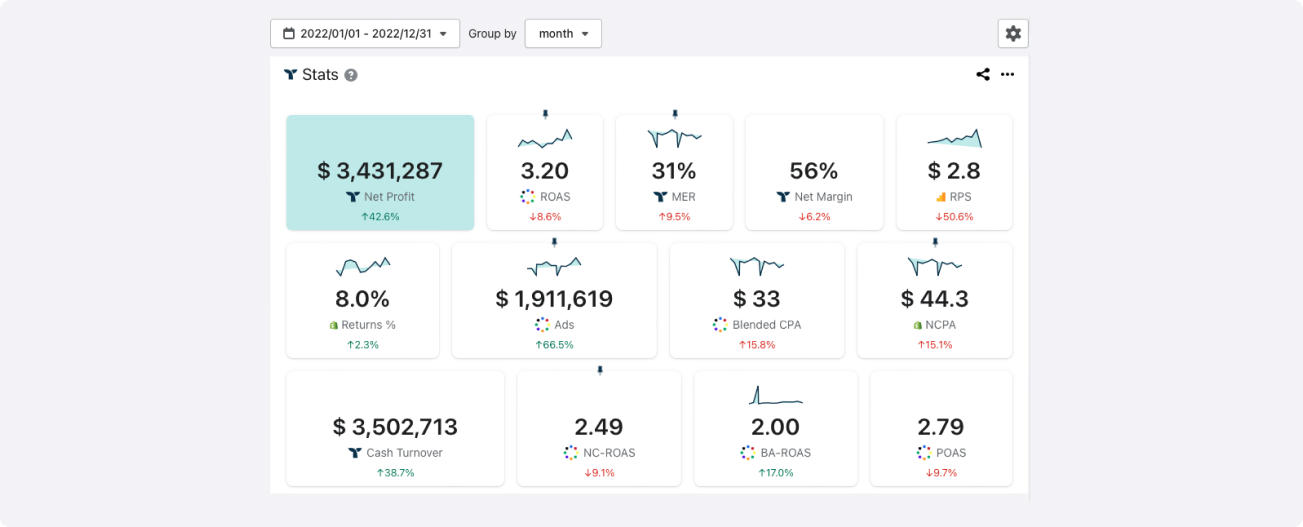
6 Impact to the bottom line
Here is the behavior that surprises new clients: we are willing to pause ads, cut budgets, and shrink our own workload when the profit math says so. Our incentives allow it, because we price on scope rather than a percentage of your spend, so recommending you spend less never costs us anything to say.
We read the account through your business data, profits, margins, cash turnover, COGS, and we treat paid social as one lever in a P&L, not a fiefdom to defend. When the constraint on growth is your offer, your landing page, your retention program, or your inventory, we say that, and we help fix it. Media buying is the craft. The bottom line is the job.
Schedule your 30 mins discovery call HERE
- Hear about our approach and how it maps to your account
- Explore whether we’re the right fit for your stage and category
- Discuss access so we can run the audit against your real numbers
Starting at $5k/month
3-month initial commitment, then month-to-month.

Frequently Asked Questions
What makes Evestar different from other Facebook ad agencies?
We manage to new customer ROAS with guardrails derived from your margin, not to in-platform blended ROAS. Structure is consolidated so the algorithm learns, creative does the targeting and is judged on hold rate rather than hook rate, and our pricing is scope-based, so recommending a budget cut never conflicts with our own fee.
How do you structure Meta ad accounts?
Testing runs in a CBO with roughly ten ads per ad set on clean signal, new creative gets three to ten days before verdicts, and winners graduate in stages into a consolidated scaling campaign with cost caps, fed weekly. Broad audiences, purposeful exclusions, and a naming convention you can actually report on.
How much creative do I need for Meta ads to work?
A steady pipeline, weighted 80 percent toward iterations of proven winners and 20 percent toward new concepts. Volume matters, but iteration discipline matters more, most brands abandon winning angles long before audiences tire of them, then wonder why the next batch missed.
How quickly will I see results?
Structural fixes show within the first learning cycles, but we judge creative on three to ten days minimum and scale decisions on stable new customer economics, not a hot weekend. We would rather build a program that compounds than a screenshot that peaks.